
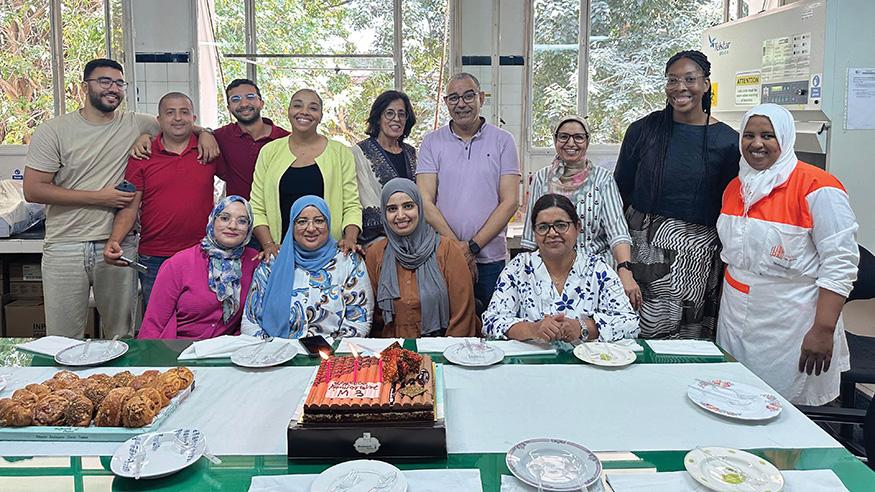
Upon learning it was Kira Banks’ (second from right) birthday later in the month, her hosts at the Moroccan National Institute of Hygiene included her in their birthday celebration tradition.
The liberal arts in action, across borders
by Genevieve Ryan ’26
Just two years after graduating, Kira Banks ’23 is already making an impact in global health.
As part of her Master of Public Health program at the University of Illinois Chicago, Banks spent eight weeks in Morocco last summer completing her Applied Practice Experience (APE). She partnered with researchers at the Moroccan National Institute of Hygiene (NIH) to study the feasibility of a monthly congenital toxoplasmosis screening program in the region of Draa-Tafilalet.
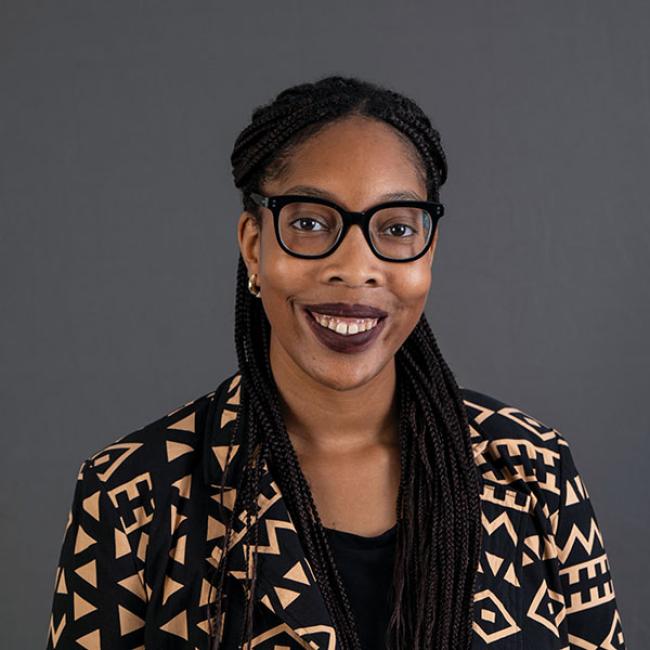
Kira Banks ’23
Toxoplasmosis is a significant but under-addressed public health issue in Morocco, where an estimated 37% to 51% of women of reproductive age have been exposed. Infection during pregnancy can lead to severe complications, including neurological damage and vision loss in infants. Morocco currently lacks a national screening protocol.
Banks divided her time between Rabat and Errachidia, analyzing health system data and working directly with midwives and nurses in regional clinics. The work demanded adaptability, including navigating a multilingual environment. The first days of the program at the NIH were filled with lectures, work sessions and tours, all conducted in Arabic, Darija and French.
“Despite my language preparation, the first few days of the program were a language shock,” Banks said. “But by day three, I was able to better understand my colleagues.”
Her work included developing a questionnaire for health professionals and contributing to the analyses aimed at improving screening and treatment access. The team’s findings are now being prepared for publication with the goal of informing policy in Morocco and advancing global conversations on congenital toxoplasmosis.
Banks credits Augustana’s public health program with helping her transition smoothly into graduate-level fieldwork and research.
“It prepared me exceptionally well for my MPH, not only through content but also professionalism,” Banks said. “Our internship and capstone deliverable process were the same as our APE at UIC. I felt very comfortable putting myself out there.”
At Augustana, Banks triple-majored in public health, biology and Classics — a combination that proved more interconnected than it may seem. While biology and public health grounded her in science and policy, her study of Classics shaped how she thinks, solves problems and communicates across differences.
“Evidence-based public health interventions are often politicized, and much health policy work involves informing and convincing opponents that the evidence is the evidence,” Banks said. “My background in Classics helps me learn to alter perspectives with openness and curiosity.”
“My background in Classics helps me learn to alter perspectives with openness and curiosity.”
Dr. Kirsten Day, professor of Classics, is never surprised when alumni talk about the value of studying Classics.
“Classical antiquity permeates our world: it is present in the stories we tell, in our art and our architecture, and, for better and sometimes worse, in our values, customs and ideologies,” she said. “Studying these traditions not only deepens understanding of the past but also builds the logical reasoning, critical thinking and ethical reflection needed to engage the present.”
For Banks, those skills have been essential, whether navigating language barriers, understanding cultural contexts or working across perspectives to build effective health solutions with her team.
Banks graduated with her Master in Public Health last month. She plans to pursue work in research and global health, and is considering a doctorate in global health or medical anthropology.
Her time at Augustana is a reminder of something liberal arts advocates have always understood — that the most pressing problems rarely fit neatly within a single discipline, and that the individuals best equipped to solve them are often the ones who refused to choose just one.