
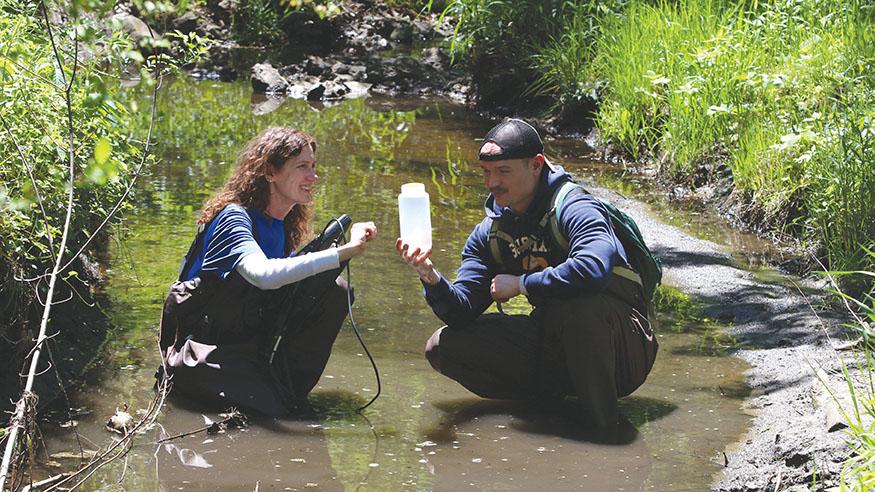
Dr. Kimberly Murphy and Caleb Bishop ’28 collect water samples in Robin Creek as part of a partnership with the City of Davenport and Augustana’s Center for the Advancement of Community Health and Wellness.
Real impact, powered by students
Since its launch in 2022, Augustana’s Center for the Advancement of Community Health and Wellness, or CACHW for those in the know, has been doing exactly what its name says.
In the pursuit of health and wellness, students have developed movement classes for older adults in Moline; developed surveys and analyzed results that helped secure additional funding for the YWCA Quad Cities Empowerment Center; and helped identify and inventory lead drinking water service lines in Rock Island.
“Our projects bring together students from all majors — with different skill sets and perspectives — to help tackle real-life problems in our local communities,” said Dr. Kimberly Murphy, CACHW director and professor of biology.
To fully understand how CACHW is making an impact, here are three recent projects in the Quad Cities:
- Cleaner urban water
- More equitable, connected maternal health care
- Language skills to navigate U.S. health care system and support personal wellness
1. Cleaner urban water
Under the mentorship of Dr. Murphy, biology major Caleb Bishop ’28 is studying how in-stream biofilters may improve urban water quality in Davenport, Iowa, and what biological mechanisms may be involved.
“Special stream filters offer a passive, low-maintenance and chemical-free approach to improving water quality, making them an attractive option for urban stream restoration,” Dr. Murphy said. “The goal here is to better understand how these systems reduce contamination and improve the health of urban streams.”
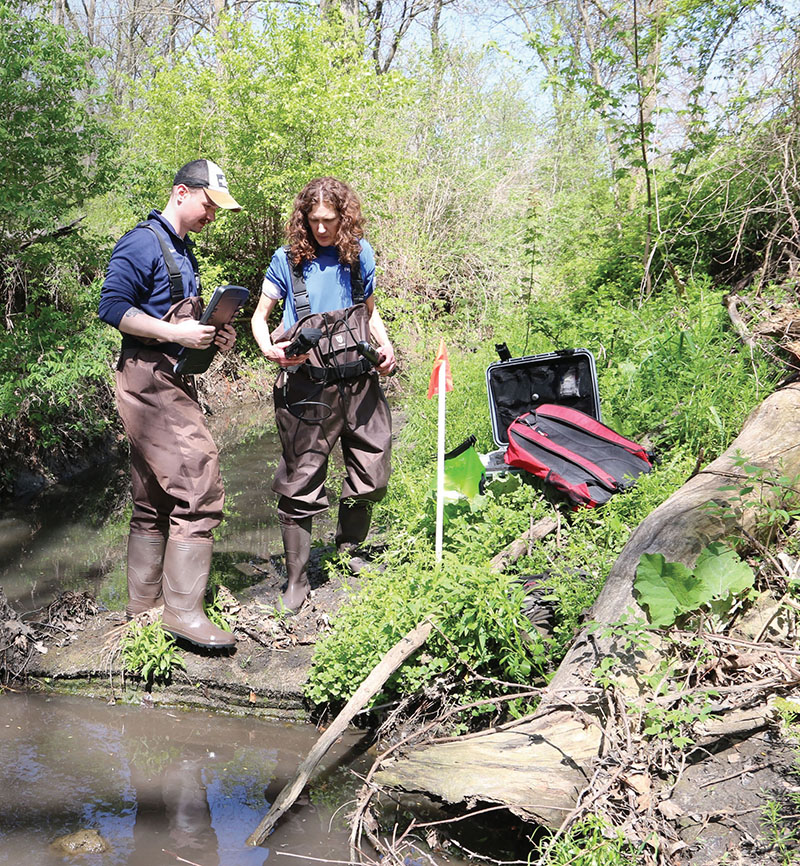
Caleb Bishop ’28 and Dr. Kimberly Murphy stand on a biofilter in Davenport’s Robin Creek.
In-stream biofilters were installed in Robin Creek (2020) and Goose Creek (2024) to reduce levels of Escherichia coli (E. coli). Monitoring has shown signs of reductions downstream of these systems. However, the biological processes responsible for these improvements are not well understood, according to Bishop.
His project investigates whether bacteriophages — viruses that infect and destroy bacteria — are associated with E. coli reductions in the biofilter reaches of the two creeks. Bishop was awarded an Augustana Summer Research Fellowship from the Student Research Committee to pursue this work.
Unlike earlier studies that focused mainly on upstream and downstream comparisons, Bishop has expanded his study by sampling the entire reach of the biofilter installations for a more complete dataset to help understand how the biofilters function.
The project gives Bishop direct experience with laboratory techniques, microbial culture assays, field sampling, water quality testing, data collection and statistical analysis, Dr. Murphy said. She added that the experience also builds broader scientific skills.
“He is strengthening his ability to collect, analyze and interpret biological data while engaging with scientific literature and refining research questions through the research process,” she explained.
Unlike structured classroom labs, field research introduces uncertainty and variability.
“Hands-on lab work and fieldwork allows students to work with real, variable systems where there are no ‘perfect’ conditions or guaranteed outcomes,” Dr Murphy said. “In the classroom, concepts may be simplified and isolated, but in this project, Caleb is seeing how those same concepts interact in complex ways.
“It shifts learning from memorization to decision-making. This strengthens understanding by having Caleb actively applying methods rather than just learning about them.”
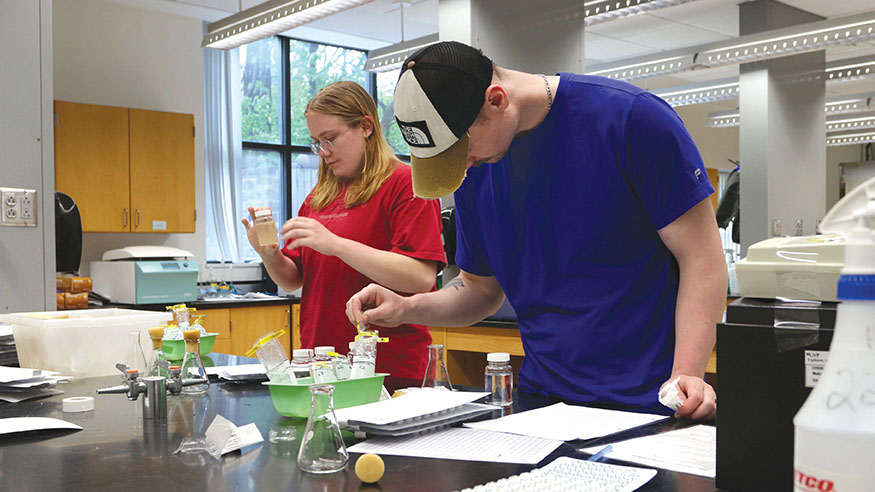
Back in the lab, Caleb Bishop and Mallek Newkirk ’28 test the water samples to detect and quantify total coliforms and E. coli.
For Bishop, the experience has reshaped both his interests and future plans.
“I love fieldwork,” Bishop said. “Having grown up in the country, I have always enjoyed being outdoors. Fieldwork combines the best of both worlds — science and nature.”
He admits what he’s doing now is not what he expected to be doing at Augustana.
“I originally wanted to study biology in order to continue working in health care as a medical lab scientist,” he said. “However, this project and Augustana’s incredible faculty have helped reignite my passion for nature, and helped me discover an interest in pursuing environmental research.”
He now plans to study plant pathology or soil science with a focus on environmental and agricultural sustainability in graduate school. “I have become intrigued by how microorganisms, watersheds, and agricultural and industrial practices interact to shape community health,” he said.
Bishop also has discovered that conducting research to support local environmental efforts is personally rewarding.
“It feels very meaningful to be doing research with CACHW that could positively impact a neighboring community,” he said. “Knowing that the data we collect on microbial communities and environmental conditions in local streams could ultimately help inform efforts to improve water quality in the Quad Cities makes the work feel more impactful."
“It adds a sense of responsibility and purpose to our project, knowing our efforts can have a positive impact on the ecosystems in our own backyards.”
That connection between student learning and community benefit is central to CACHW’s mission, Dr. Murphy said. She also highlighted the mentoring aspect of the work.
"Knowing that the data we collect on microbial communities and environmental conditions in local streams could ultimately help inform efforts to improve water quality in the Quad Cities makes the work feel more impactful."
“The most rewarding part for me has been mentoring an engaged and enthusiastic student through the research process and watching him grow in confidence,” she said. “Seeing Caleb develop ownership of the work, ask deeper questions, think critically about data and connect field observations to broader scientific concepts has been especially meaningful.”
After sampling concludes this fall, Bishop will move into data analysis and prepare findings to share with the City of Davenport and Partners of Scott County Watersheds to support their restoration efforts.
2. More equitable, connected maternal health care
Through a partnership focused on improving care for pregnant women and families, CACHW is helping turn maternal health research into action across the Quad Cities.
Working alongside Community Health Care, Inc., The Birthwork Foundation, and Akwaaba QC, CACHW is part of a broader initiative funded by a “Solutions at Scale” grant from the Better Health Foundation. The effort focuses on strengthening prenatal care, reducing disparities in birth outcomes, and improving maternal and infant health across the region.
The grant builds on CACHW students’ earlier research into maternal health disparities in the Quad Cities, which found significant gaps in care. A significantly higher proportion of Black mothers rated their care as “poor” compared to white mothers, according to Dr. Murphy.
The students’ research also highlighted a need for stronger connections between medical providers and doulas, along with better awareness of resources such as breastfeeding and parenting classes.
The new initiative aims to use these findings to create more equitable, connected care for families. CACHW’s role in evaluating the data is the heart of the project. Dr. Murphy describes the work as a blend of research, data and community engagement.
CACHW students will continue analyzing results from pre- and post-surveys they created for pregnant patients, doulas, clinicians and care providers. They will then translate findings into practical recommendations. The work will culminate in evaluation reports, participation analysis and a sustainability plan shaped by both data and community feedback.
Opportunities like this equip students with a more adaptable and transferable skill set, better preparing them for life beyond graduation, Dr. Murphy points out.
“By applying course concepts in real-world settings, the students develop a deeper and more meaningful connection to the academic content,” she said. “Additionally, these experiences foster intercultural understanding and strengthen students’ values as they engage with diverse communities and contexts.”
Alyssa Klauer ’22, CACHW sustainability program manager, emphasized the collaborative spirit behind the effort.
“This partnership brings together organizations deeply committed to maternal health in the Quad Cities,” Klauer noted, “and we’re ready to turn data-driven insights into measurable improvements for mothers, children and families across our community.”
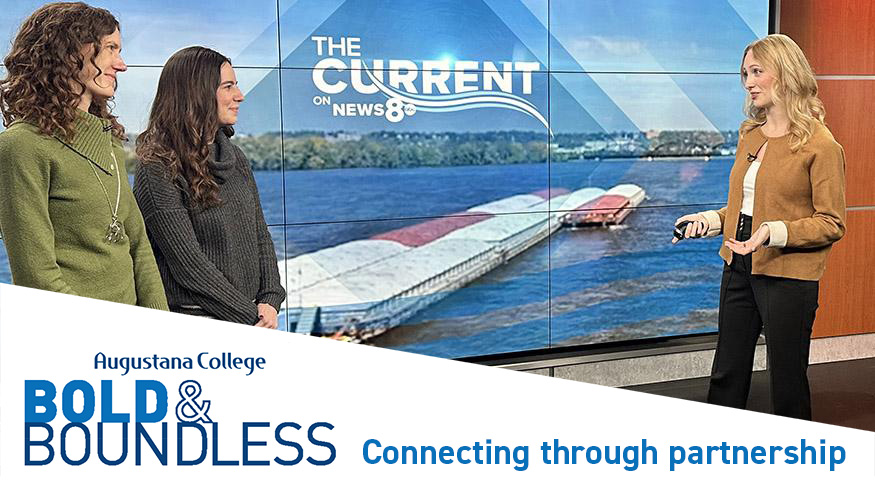
Augustana partners with local organizations to improve maternal care
Augustana's Center for the Advancement of Community Health and Wellness (CACHW) is partnering with Community Health Care (CHC), Iowa Black Doula Collective, and Akwaaba QC to improve maternal care in the region.
3. Language skills to navigate U.S. health care system and support personal wellness
The mission of World Relief Quad Cities, based in Moline, Ill., is to help refugee and immigrant families in the community find support, belonging and the opportunity to flourish.
A Family Literacy Program (FLP) staffed by World Relief employees and volunteers currently serves nearly 40 participants from all over the world.
To provide more direct language-translation support, a seven-session program with Augustana students was developed by FLP and CACHW’s Alyssa Klauer.
With program support from the Better Health Foundation, seven Augustana students were hired to translate materials and lead conversations on how to navigate the U.S. health care system, advocate for physical and mental well-being, and access needed resources.
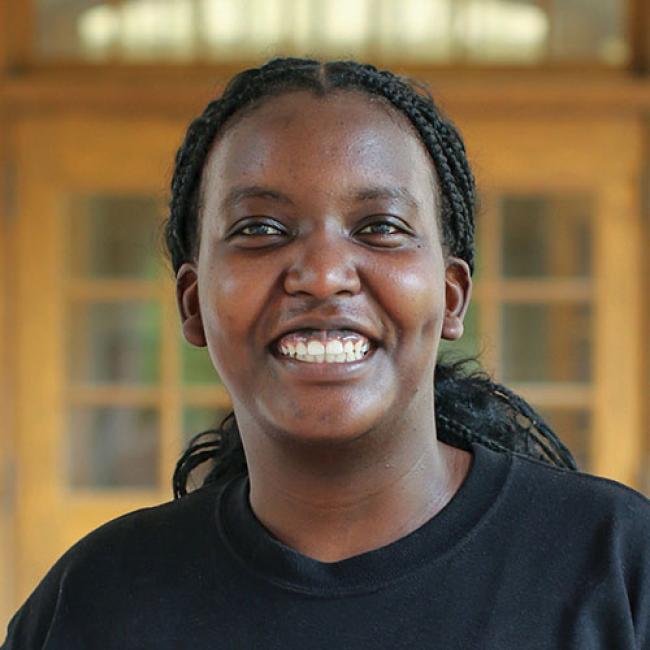
Bella Rudasingwa ’29
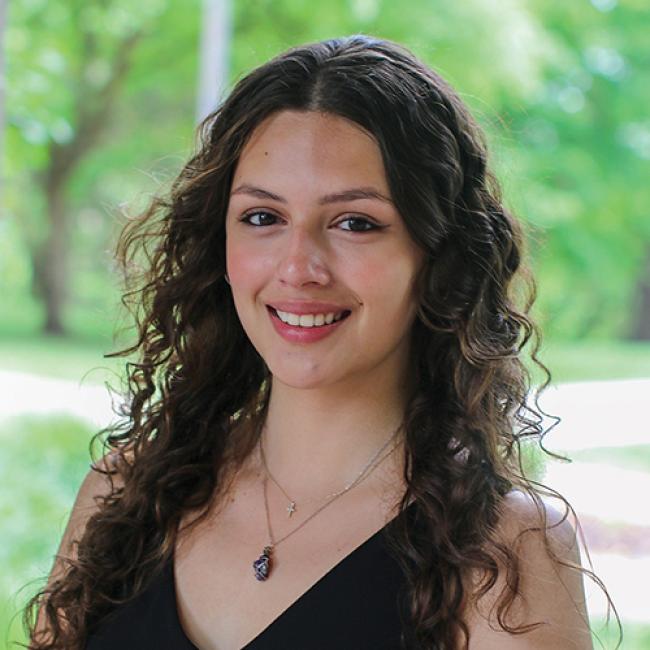
Elisa Garcia ’29
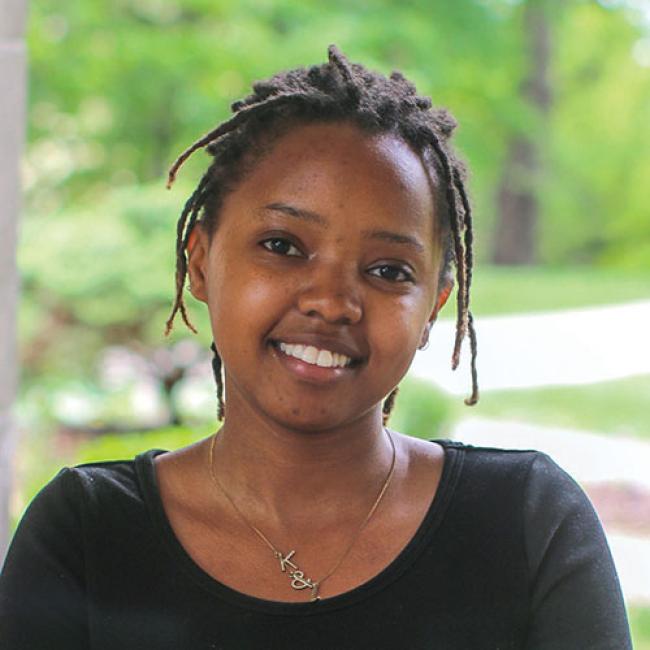
Kayla Kuria ’29
The students represented their home countries of Kenya, Rwanda, Cameroon, Guatemala, Mexico and Afghanistan. They are fluent in English as well as Swahili, Kinyarwanda, French, Dinka, Spanish or Dari. Each student worked with one to 12 participants during weekly sessions. They provided consistent, language-specific and culturally responsive support in their small groups.
“What I love most about this work is the chance to help my fellow Rwandans navigate a path I’ve walked myself,” said Bella Rudasingwa ’29 of Kigali, Rwanda, who speaks Kinyanwanda. “When I first joined the Augustana community, people looked out for me and helped me find my footing, so being able to offer that same hand to others feels like things have come full circle.”
The partnership is clearly mutually beneficial. Participants improve their English skills in real-world health care situations so they can more confidently advocate for themselves and their families. Students benefit by engaging in learning experiences for their own growth and increased confidence.
“Professionally, this experience has given me hands-on exposure to community-based work and deepened my understanding of the challenges refugee populations may face,” said Elisa Garcia ’29 of Guatemala City, Guatemala, who speaks Spanish. “Academically, it has reinforced my interest in global issues and the importance of culturally informed approaches to problem-solving. It has brought me closer to the type of work I hope to pursue in the future.”
Kayla Kuria ’29 of Mombasa, Kenya, helped new community members who speak Swahili.
“This work is important to me since I am an advocate for equality in education, and I see this as making an impact with people working together to support the lesser advantaged,” Kuria said.
The success of the program could lead to additional translation-support sessions on topics including mathematics and financial literacy, job searching and employment preparation, understanding the American school system and navigating public transportation.
“Working with CACHW has taught me that growth really just comes down to being willing to put yourself out there,” Rudasingwa said. “You don’t need something massive to change a community. Seeing how just one hour-long session a week can actually change someone’s life showed me that my ideas for the future are actually possible.”