
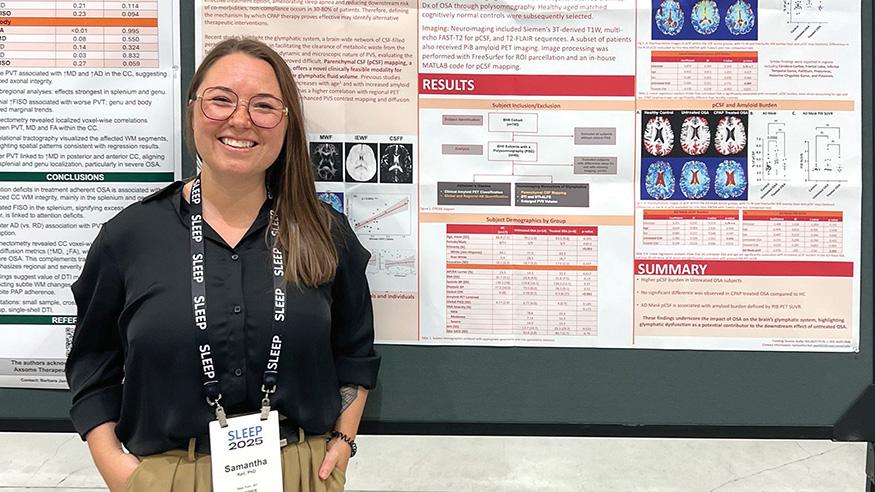
In looking back on her Augustana experience, Dr. Samantha Keil '12 says two mentors truly catalyzed her passion for neuroscience research.
Studying a link between sleep and Alzheimer’s, dementia
The July 10, 2025, issue of Science, one of the world’s top academic journals, features Dr. Samantha Keil ’12 as lead author on an article that summarizes what research has revealed about how the brain’s glymphatic system may play a role in Alzheimer’s disease.
The glymphatic system helps clear waste from the brain. Research in animals has shown that it helps in removing two proteins —amyloid beta and tau — that are linked to Alzheimer’s disease.
Dr. Keil’s work focuses on understanding whether this brain “cleaning” system functions the same way in humans, and whether it could be targeted for new treatments to improve the outcomes for the millions of people suffering from neurodegenerative diseases.
“This work is important because poor sleep, including untreated OSA, is a major risk factor for diseases like Alzheimer’s and dementia.”
Her review in Science outlines current progress in human studies, and while results are encouraging, there’s not yet clear proof that changes in the glymphatic system directly affect the progress of disease.
Unfortunately, like most systems in the brain, the glymphatic system is difficult to study directly in people. New MRI techniques show promise in capturing its structure and fluid movement, but the best method is still unknown. Dr. Keil says combining these scans with blood and spinal fluid tests could help develop treatments, including drugs and wearable devices, to improve glymphatic function.
It’s important to note that the glymphatic system is most active during sleep. Dr. Keil’s own research focuses on how good sleep, this waste-clearing system in the brain, and disease progression are all connected.
“In my developing research program, I aim to use neuroimaging approaches to evaluate the impact of sleep on brain fluid clearance metrics across clinical populations,” she said.
Dr. Keil recently received the Weill Cornell Medicine Clinical and Translational Science Center’s KL2 Career Development Award. As a KL2 Scholar at Weill Cornell Medicine in New York City, she is using new MRI techniques to study how the glymphatic system is affected in people with obstructive sleep apnea (OSA). She is also investigating whether CPAP treatment can help improve this system’s function.
“This work is important because poor sleep, including untreated OSA, is a major risk factor for diseases like Alzheimer’s and dementia,” Dr. Keil said.
In looking back on her Augustana experience, Dr. Keil says two mentors truly catalyzed her passion for neuroscience research.Professor Emeritus Dr. Bob Tallitsch taught anatomy and neuroanatomy, led the traditional Chinese medicine course during her East Asia study abroad, and served as the faculty advisor for her senior thesis project focused on pediatric neuroplasticity.
“Bob taught me to think outside the box, evaluate the system holistically and to always be open to learning what I do not know,” she said. “He was the first exposure I had to the type of mentor, educator and collaborator I strive to be with my team.”
Dr. Keil also considers herself fortunate to have been in the first class of Augustana’s neuroscience major in 2011 with Dr. Ian Harrington and Dr. Shara Stough. The class of only 20 students spent an intensive immersion term learning the biologic, psychologic and philosophic underpinnings of the neurosciences.
“Having Dr. Harrington as my primary mentor during this experience was instrumental, and he’s never stopped supporting my continued advancement in the field,” she said. “I have been lucky to return to discuss my experience, my research questions and the techniques I love to his classes over the years.”
More than a decade after her undergrad years at Augustana, Dr. Keil still describes her experience and the opportunities she was given as unparalleled.
“My professional and personal Augie network is still going strong,” she said, “and I am honored to be able to contribute to expanding that network for the students and mentees who find themselves as impassioned in science and medicine as I was.”