
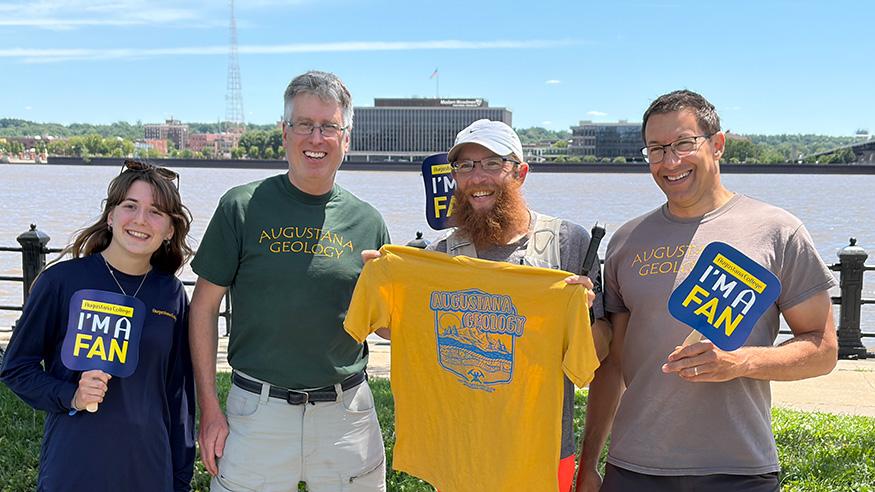
Augustana geology major/runner Sammy Lehr '27, Dr. Jeff Strasser, Grant Bell '15, and Dr. Mike Wolf on the Mississippi River Trail
Bell ’15 runs the Mississippi River Trail to fight childhood cancer
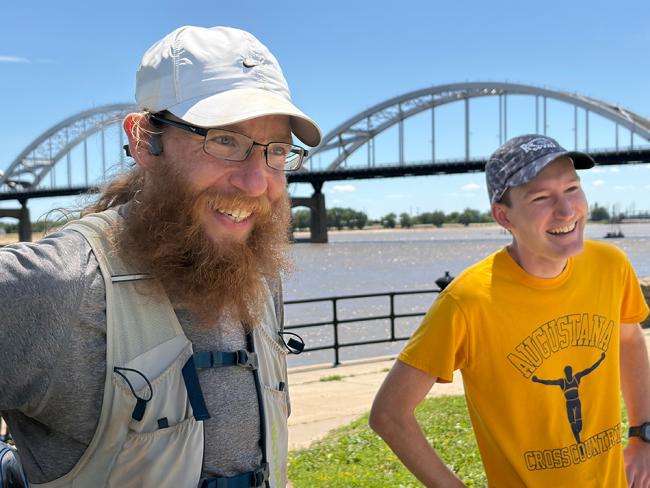
Grant Bell and former teammate Jordan Franks '16
When former Viking Grant Bell ’15 ran through the Quad Cities today, the route felt familiar.
This summer, Bell is attempting to run the entire length of the Mississippi River — a journey of roughly 2,300 miles from northern Minnesota to southern Louisiana — to raise money for childhood cancer research.
As he made his way along Iowa’s Mississippi River Trail, where he trained while attending Augustana, two of his former geology professors, Dr. Mike Wolf and Dr. Jeff Strasser, met up with him to offer encouragement and reconnect. Former teammate Jordan Franks ’16 also joined him for a stretch from the Centennial Bridge to Credit Island.
Born and raised in St. Cloud, Minn., on the banks of the Mississippi River, Bell has spent most of his life running. He competed through high school and college and is now a running coach, logging nearly 20 miles a day in training. His day job is makerspace manager at Illinois Mathematics and Science Academy.
Bell’s Mississippi River run began in late May and is expected to take about 70 days, covering 30 to 40 miles per day. His dad, Barry Bayerl, is driving his support trailer.
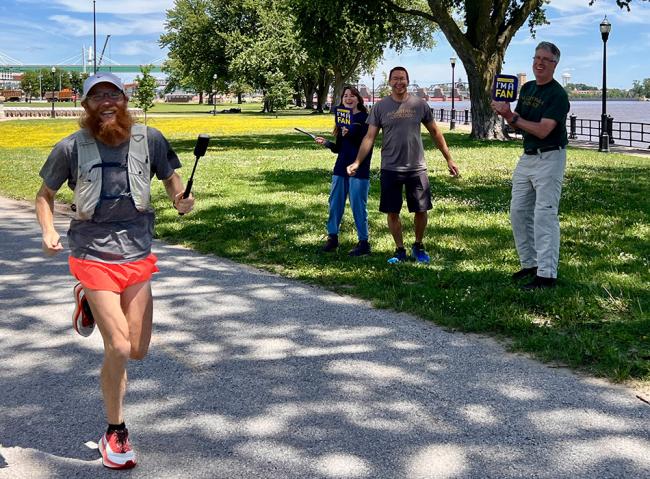
After running with former Viking coach Fred Whiteside '74 for a while, Grant Bell meets up with a small but mighty Augustana cheering section.
The motivation behind the effort is deeply personal.
“Less than a year ago, my niece was diagnosed with Ewing sarcoma, a rare, aggressive cancer that primarily develops in the bones or surrounding soft tissues of children, teenagers and young adults,” wrote Bell on his GoFundMe page.
He said watching his niece endure treatment inspired him to use his passion for running to help others facing similar challenges.
Bell also understands hardship from his own childhood experience. As a young boy, he was diagnosed with an incredibly painful disease called Legg Perthes.
Quite rare and even more debilitating, this disease is a childhood hip disorder where the blood supply to the femoral head (ball of the hip joint) is temporarily lost, causing the bone to break down and die, according to Bell. A limp, pain in the hip and leg, and muscle atrophy are all symptoms that come with Legg Perthes.
While the bone eventually heals through a process of re-ossification, it can take several years, and the hip may be left with a different shape that affects movement for life.
“Although my experience was painful and difficult, and it could have affected me for the rest of my life, it didn't,” Bell said. “Instead, I experienced what I could only label as a miracle. After a matter of weeks, not years, of being in a wheelchair, my pain went away and I was able to stand and walk with a correctly formed hip. I was able to walk, to jump and, most importantly, to run.”
Today, Bell views running as both a gift and a responsibility.
“For a long time, I lived and ran ‘because I could,’” he said. “Now, so many years later, I still run because I can, but also because I can’t not. Running has grown from being a part of my life, to my life. I have been lucky, very lucky, and want to help others prosper with what I can do that they might not be able to.”